Sale 1244 — The Arthur S. Przybyl Collection of United States, Confederate States and Hawaii
Sale Date — Tuesday-Wednesday, 9-10 November, 2021
Category — Air Post, including Inverted "Jenny" Position 3 (Scott C3a)

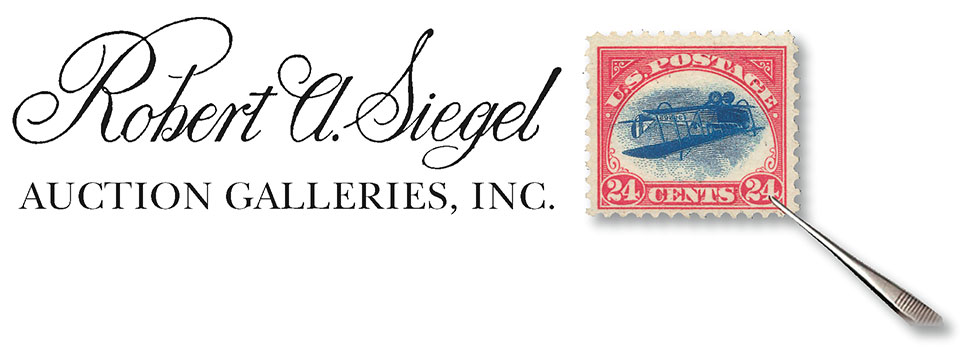
 24c Carmine Rose & Blue, Center Inverted (C3a). Position 3, original gum with some disturbance which is very minor, pencil "3" position number on back applied by Eugene Klein, natural straight edge at top
VERY FINE. A SCARCE SOUND EXAMPLE OF THE FAMOUS 1918 24-CENT INVERTED "JENNY" ERROR--THE MOST FAMOUS STAMP IN AMERICAN PHILATELY.
The original sheet of one hundred Inverted Jenny errors was purchased by William T. Robey on May 14, 1918, the first day the stamps went on sale in all three principal airmail route cities: Washington, D.C., New York and Philadelphia. Robey bought the sheet for its $24 face value at the New York Avenue Post Office window in the District of Columbia. On Sunday, May 19, Robey agreed to give Eugene Klein, a prominent Philadelphia stamp dealer, a one-day option to buy the sheet for $15,000. Klein exercised his option on Monday, May 20, in a late afternoon phone call, and he confirmed it with a registered letter to Robey sent in the evening mail. The sheet was delivered to Klein’s office by Robey and his father-in-law on the following day, Tuesday, May 21, 1918.
No later than Monday, May 20, the day Klein exercised his option, he had arranged to sell the sheet for $20,000 to Colonel Edward H. R. Green. Half of the $5,000 profit went to Klein’s partners, Percy McGraw Mann and Joseph A. Steinmetz. Klein was then authorized by Colonel Green to divide the sheet into singles and blocks, and to sell all but a few key position blocks.
Despite the great rarity and value of Inverted Jenny stamps, many of the original hundred have been mistreated by collectors over the years. Colonel Green himself allowed moisture to affect some of the stamps he retained. Eight straight-edge copies that Klein was unable to sell and returned to Colonel Green were found in Green’s estate stuck together in an envelope (they were soaked and lost their gum). Other examples have become slightly toned from improper storage and climatic conditions. Hinge removal has caused thins and creases in numerous stamps, and one was physically Scotch-taped to an exhibit page. Another was nearly lost to philately forever when it was swept up in a vacuum cleaner.
Position 3 must have been sold when Eugene Klein broke apart the sheet. The first auction appearance we could find was in a May 30, 1974, J. & H. Stolow auction. In April 1976, dealer Lambert Gerber offered the stamp by private treaty. It made three auction appearances between 1981 and 1988, and was last sold at auction in a 2004 Spink-Shreves sale.
Ex Colonel Edward H. R. Green. With 2021 P.F. certificate stating "genuine, previously hinged, with some gum disturbance".

