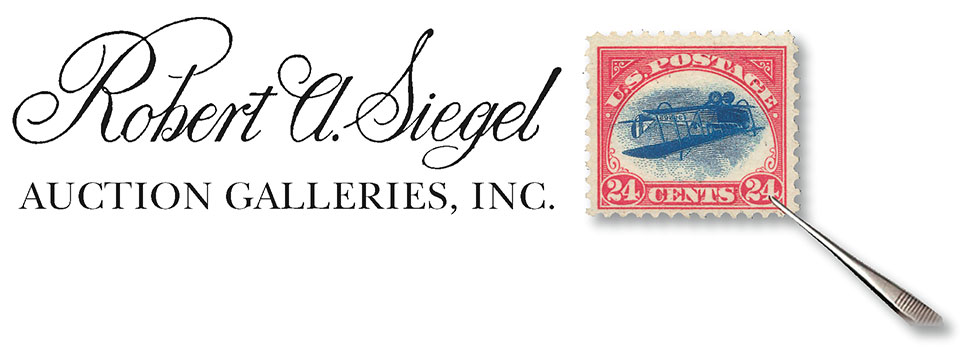
Sale 1096 — The Robert R. Hall Collection of Outstanding United States Stamps
Sale Date — Tuesday-Thursday, 28-30 April, 2015
Category — Air Post with Inverted Jenny, Position 69 (Scott C1-C3a)

 24c Carmine Rose & Blue, 1918 Air Post (C3). Top arrow, double plate nos. 8493/8492 and two "TOP" block of twelve, four stamps and selvage lightly hinged, others Mint N.H., bright colors, few perf separations, top left stamp natural pre-printing paperfold, one at bottom natural inclusion, Fine-Very Fine


 24c Carmine Rose & Blue, 1918 Air Post (C3). Mint N.H., forward shift of plane vignette into the frame, approaching the "fast plane" variety, huge balanced margins, Extremely Fine Gem, a wonderful combination of centering and vignette shift, with 2002 P.F. certificate, Scott Retail as normal
 24c Carmine Rose & Blue, 1918 Air Post (C3). Position 21 with left selvage, Mint N.H., rich colors, vignette shifted strongly to bottom with wheels just short of touching "CENTS", Fine, Sanabria handstamp guarantee with position number 21 in pencil, this is from the Sanabria sheet, at the time it was thought that in the upper rows of the sheet the shift was strong enough to qualify for the "grounded plane" variety--today's standard requires that the wheels need to touch or go into "CENTS"--a "low flying" or "nearly grounded" variety nonetheless

 24c Carmine Rose & Blue, Center Inverted (C3a). Position 69, lightly hinged, deep rich colors, well-centered
VERY FINE AND CHOICE. ONE OF THE WIDEST-MARGINED AND FRESHEST EXAMPLES OF THE FAMOUS INVERTED JENNY.
According to Jenny! by George Amick (Amos Press, 1986), the original sheet of 100 inverted "Jenny" stamps was purchased by William T. Robey on May 14, 1918, one day after the stamp was placed on sale. Robey bought the sheet at the New York Avenue Post Office window in Washington, D.C. Soon after, the sheet was sold to Col. Edward H. R. Green through Eugene Klein, a Philadelphia stamp dealer. Green paid $20,000 for the sheet, then instructed Klein to divide it into singles and blocks, and to sell all but a few key position blocks.
It is well-known among stamp specialists and professionals that examples of this stamp come in different grades of freshness and condition. Many of the original 100 stamps were mistreated by collectors during the years, despite the stamps' rarity and value. Colonel Green himself allowed moisture to affect some of the stamps he retained. Other examples have become slightly toned from improper storage and climatic conditions. Hinging has caused thins and creases in numerous stamps, and at least seven have been "lost" to philately -- or nearly so as in the case of the copy swept up in a vacuum cleaner. This Position 69 stamp is in an extraordinary state of freshness, with excellent color and brightness.
With 1970 P.F. certificate