
Vignettes
Commentaries on Items in the Gross Collection
⇚ Select other Commentaries here (16 available)Wednesday and Thursday, May 8-9, 2019 — Scott R. Trepel
Sale 1200 — The William H. Gross Collection: Outstanding U.S. Stamp Multiples
1851-56 Issue
The Fascinating Corner of the 1¢ 1851 Plate 2
The new postage rates effected in July 1851 created the need for a 1¢ stamp. The design and production of the 1¢ Franklin were executed by the newly-contracted firm, Toppan, Carpenter, Casilear & Company.
The 1¢ design was a bit too large for the 200 subjects, arranged in two panes of 100 (10 by 10), to fit on the steel plate. Through trimming of reliefs on the transfer roll and short transferring of entries on the plate, the siderographer managed to squeeze 200 entries on the plate. The consequence of this “squeezing” process was a loss of parts of the design in the engravings and, in turn, the printed stamps.
Philatelists in the early part of the 20th century examined countless thousands of 1¢ 1851-57 Issue stamps, including blocks and sheets, and successfully reconstructed the stamps’ positions on the original plates. The plates are numbered in chronological sequence: Plate 1, 1 Late (the reworked first plate), 2, 3 and 4 – the plates used to make imperforate stamps – followed by Plates 5, 7, 8, 9, 10, 11 and 12 (Plate 6 was discarded), which were used only to make perforated stamps.
Once all of the stamps were categorized – basically by the completeness of the design, but also by certain design characteristics – every stamp could be assigned its basic type and Scott number. Type III in imperforate form is Scott 8, and in perforated form is Scott 21. Collectors starting to dive deep into the Scott listings will encounter additional entries for Scott 8 and 21, designated “(8) A8 1c blue, type III (99R2)” and “(21) A8 1c blue, type III (99R2)”, each with substantially higher values than the basic listings.
99R2? What’s a 99R2?
The quick answer is, it is the 99th stamp in the Right pane of Plate 2… 99 R 2.
Why is it so much more valuable than an ordinary Type III? Because it is an extreme form of the type.
Type III is characterized by breaks in the curved outer lines at the top and bottom. A Type III stamp must have clear gaps in the top and bottom lines, not one or the other (that is Type IIIa). The wider the gaps, the better. And the widest breaks occur in the 99th stamp in the Right pane of Plate 2 – 99R2. The difference is shown in the comparison photo with 99R2 at left and a normal Type III at right.
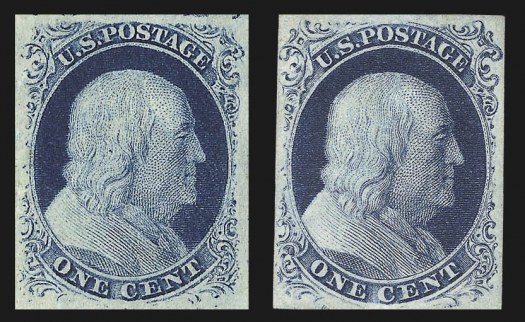
The creation of 99R2 (and the stamp above it, 89R2) is a story of human error.
Plate 2 was made in late 1855, and produced 198 stamps that are Type II, one position that is Type III (99R) and one that can be either Type II or Type IIIA (100R), depending on plate wear. To lay out the plate, the siderographer used a tool to make tiny dots in the plate that served to guide him in rocking in entries from the transfer roll.
Positions 79 and 89 were transferred perfectly using their guide dots. However, the guide dot to the southeast of Position 88R2, which was used to align the single B Relief for Position 99R2, was placed far out of line. The misplaced dot caused the siderographer to transfer the 99R entry far out of alignment and rock the adjoining A Relief on the transfer roll into the bottom part of Position 89 (and in the margin below this position).
The first 99R entry was erased and re-entered, but the parts of the A Relief transferred into the bottom of Position 89R remained. When the fresh entry was made in Position 99R, a full transfer of the design was not possible without running into the error in Position 89R. The position was therefore short transferred at top, and apparently also at bottom, creating the most extreme version of Type III found on any plate.
The nature of the right side of Plate 2 was revealed by a complete pane of 100 stamps that remained intact for the first 129 years of its existence. It was owned in succession by Arthur Hind, Mortimer L. Neinken and Ryohei Ishikawa. Soon after the 1980 Ishikawa 1¢ 1851-57 sale, the pane was cut into smaller blocks, including the plate block of 12 and the 99R2 block of 9 that was resold to Ishikawa (offered as lots 12 and 15 in the Gross U.S. Multiples sale). Many philatelists then and now regard the decimation of the Plate 2 pane as a wanton act of vandalism.
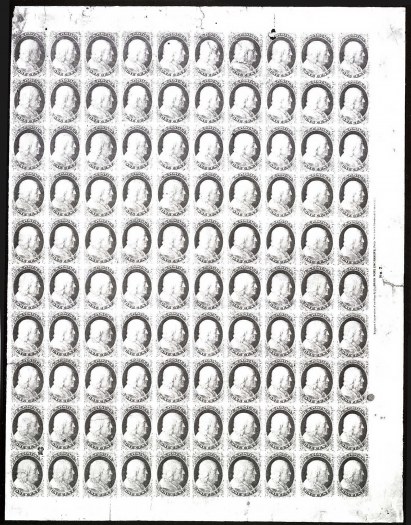
Today, there are five recorded imperforate blocks with 99R2:
1 Block of 18, Positions 82-90/92-100R2, corner margins, original gum, creases, ex Newbury (Siegel Sale 251, lot 526), unavailable to collectors, ex Hirzel, currently in the Swiss Museum of Communications
2 Block of 9, Positions 78-80/88-90/98-100R2, corner margins, no gum, small faults, cut from the ex-Hind pane of 100 — lot 15 in Gross U.S. Multiples sale
3 Block of 6, Positions 79-80/89-90/99-100R2, corner margins, original gum, creased, Siegel Sale 1037, lot 1406, currently in the Eubanks collection
4 Block of 4, Positions 88-89/98-99R2, original gum, faults including tear in 99R2, Siegel Sale 788, lot 55
5 Block of 4, Positions 89-90/99-100R2, corner margins, original gum, creased, probably cut from the Duveen block of 8, ex Hind, Ward, Siegel Sale 660, lot 25
A sixth block, ex Hessel and Klein, was reduced to a pair after the 1988 Klein sale. The perforated block with 99R2 is unique – it is offered as lot 32 in the Gross U.S. Multiples sale.